Project carried out as part of the industrial consortium FactoryLab, conducted by CETIM in collaboration with CEA-List, Safran, SLB, Stellantis, NAVAL GROUP and Altermaker.

Background
It has been shown that the environmental data present in the environmental databases and related to the processes of the End-Users are not sufficiently representative of the processes implemented within their factories. To obtain reliable, robust and representative data on processes, environmental studies specific to these processes and production equipment are necessary.
Moreover, the evaluation of social impacts in companies remains still marginal. For the evaluation of processes, it is even less mature or even non-existent in a life cycle perspective. Yet, in a coherent approach to sustainable development, the evaluation of these impacts coupled with environmental assessment seems very relevant, in particular to avoid the transfer of impact from the environmental to the social during decision-making with a view to continuous improvement of processes or when setting up new production sites.
The main objective of this study is therefore to refine a methodology for Life Cycle Assessment (LCA) adapted to processes and to complete it with a Social Life Cycle Assessment (S-LCA). This experiment should make it possible to test the S-LCA on processes, to define its applicability, contributions and limits. In this main objective, it was also a question of responding to 3 sub-objectives:
- Contribute to providing a methodology for assisting in the choice of machinery investments by proposing environmental and social criteria;
- Know the environmental and social impact of the processes studied and identify levers for action to reduce the impact of production equipment;
- Compare the environmental and social impact of processes.
Use cases and project stages
The study was conducted on 3 use cases: a tunnel washing at Safran Aircraft Engines, a manual welding station for NAVAL GROUP and a semi-automatic welding station at SLB.
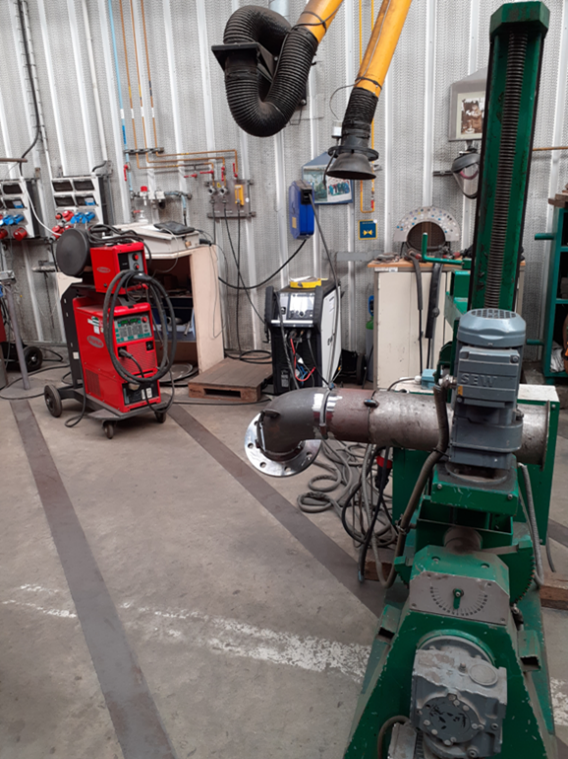
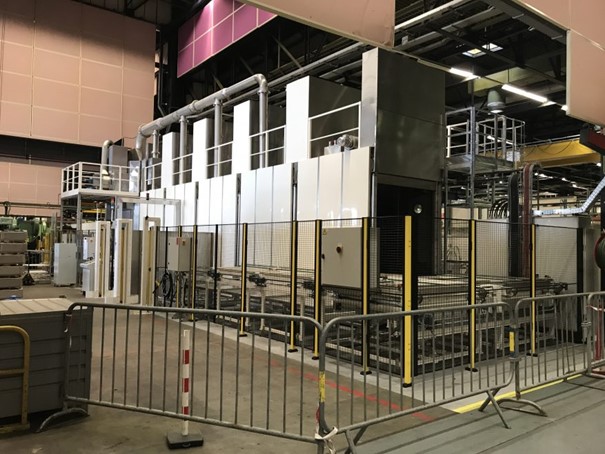
In the 3 cases, the objective is to test the environmental and social life cycle analysis methodology, to test its robustness for widespread application to production equipment.
In order to successfully carry out this project, it was initially necessary to conduct a state of the art on social impact assessment methods in order to identify the most relevant approach for industrial processes: the S-LCA. Then, a participatory approach involving the end-users made it possible to select the categories of stakeholders and subcategories of social impact of interests. Finally, this first step made it possible to precisely define the scope of the studies, the functional units, the databases to carry out the LCA and the S-LCA.
The second step that is key to the success of these evaluations is the collection of data to carry out inventories of the inbound and outbound flows of the processes in question. This step is particularly delicate and time-consuming but essential for the quality of the results that result from it.
Finally, the modeling was done on dedicated software recognized in the market. The LCA study will also be tested on a new version of the software developed by Altermaker which complements the old version to be even more ergonomic and adapted to industrial processes, particularly for easily coupling several steps in a process.
Results
Thanks to this methodology, environmental and social data are calculable and could contribute to machine investment choices.
Furthermore, the methodology would allow for input into upstream considerations of industrial projects, particularly during the definition of specifications for the acquisition of new production equipment, or even to compare different options according to environmental and social criteria.
Finally, some limitations have been identified, particularly with regard to the availability and quality of the data necessary for LCA and S-LCA. To overcome these difficulties, it is recommended to prioritize suppliers capable of providing reliable information on the social and environmental impacts of their equipment. Failing this, the methodology can also be applied to existing processes in order to optimize their performance by identifying the inputs (raw material and/or energy) that have the most social and environmental impact.
Conclusion & outlook
It has proven to be relevant for manufacturers to better understand the evaluation of their production processes. The LCA adapted to the processes has indeed allowed them to understand the causes of impact and prioritize the actions to be taken to reduce their environmental footprint, including energy consumption. Moreover, in order to complete this vision to produce more sustainably and avoid impact transfers, the S-LCA experiment was also relevant because it allows identifying social impacts throughout the supply chain of industrial processes. Although the methodological maturity of the LCA is more advanced than that of the S-LCA, the latter nevertheless allows for the evaluation of social risks and opportunities. This evaluation could be carried out at a lower cost based on the model developed for the LCA. This approach also facilitates interpretation and increases the consistency of the two analyses. Moreover, the involvement of stakeholders from the beginning of the project for the choice of impact categories is essential but is delicate because it requires a good appropriation of the stakes of these choices, of the considered perimeter and an alignment of views between several internal company stakeholders on the materiality of the impacts for the company. In conclusion, this experiment has opened the door on the importance of combining LSA and S-LCA and supports corporate strategies in their CSR trajectory and purchasing policy.
Author: Sylvaine SAINT-JALMES, SustainableProdScore project manager, CETIM.