Project carried out as part of the FactoryLab industrial consortium, led by CEA-List in collaboration with CETIM, Safran, SLB, Stellantis and NAVAL GROUP.

Part 1: Background
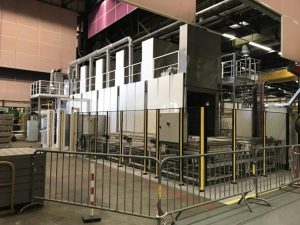
On the studied site, the scheduling aims to organize the sequencing of machining operations in a CNC machine park. The current process relies on an experienced scheduler (human), capable of integrating part geometry, cycle times, machine compatibility and tooling constraints, then usually on a software execution and control tool, which contributes to smoothing the execution in the automated area. The strong point of the current organization is the ability to react quickly: the scheduler can reallocate tasks and the scheduling software tool can propose alternatives in order to limit the impact on deadlines. This man-made coupling system allows production to be maintained in accordance with delivery commitments, even in the presence of unforeseen events.
Pour comprendre précisément ce qui fonctionne et ce qui bloque, l’équipe projet a réalisé une enquête qualitative combinant observation in situ et entretiens semi directifs sur deux environnements, un centre d’usinage automatisé comprenant quatre machines CNC et une cellule robotisée, puis un atelier d’usinage manuel caractérisé par une variabilité plus forte. Sept entretiens ont été conduits avec un ingénieur ordonnancement, un ordonnanceur, un superviseur de site et quatre opérateurs machine.
Part 2: Challenges & innovation
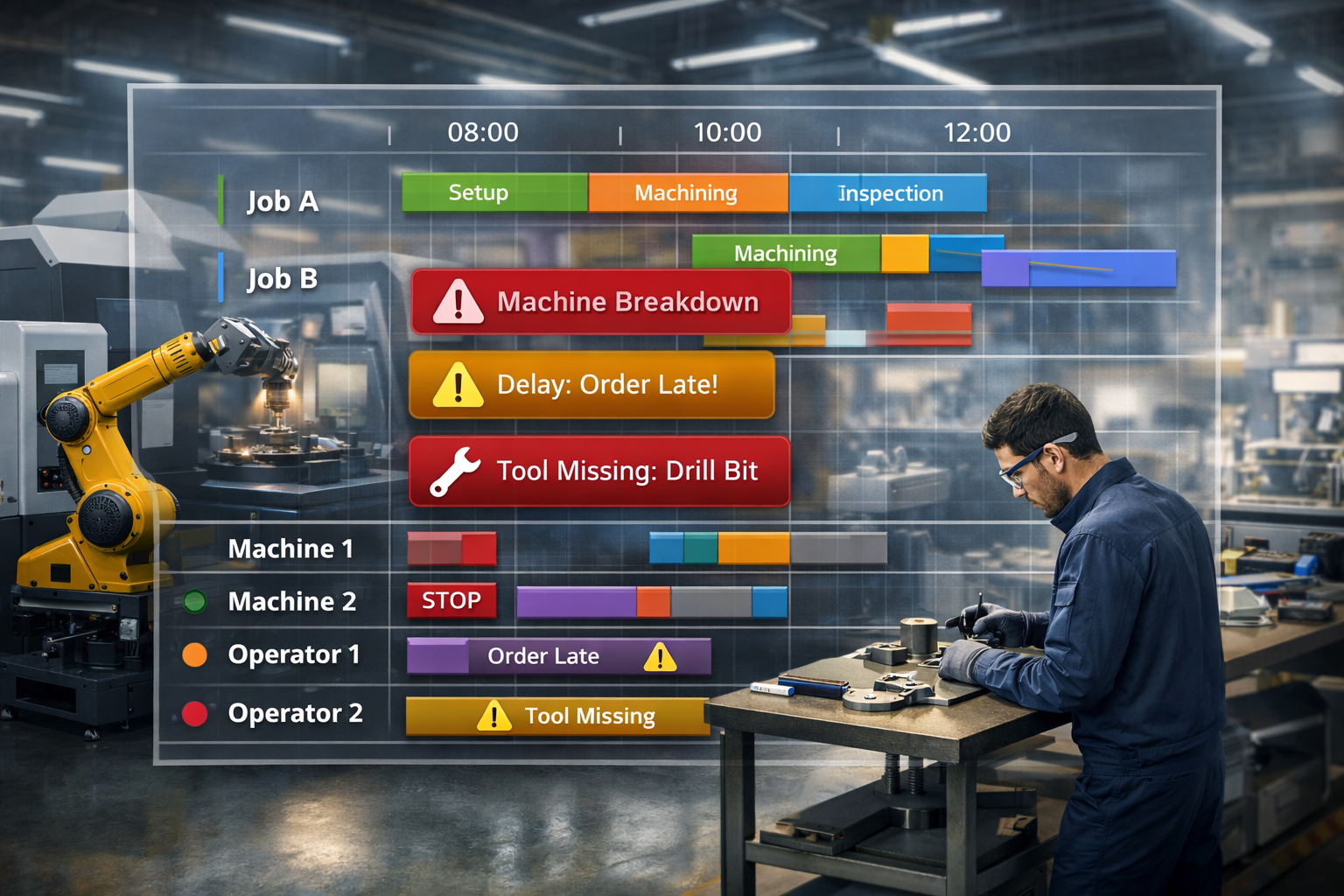
Field feedback converges on a finding: the current tool responds correctly to local execution, but it is insufficient when it comes to anticipating, arbitrating and replanning on a broader scale. The scheduling software provides a short-term view, typically limited to seventy-two hours, without a sliding planning mechanism. The system is essentially single input and does not naturally handle multi-flow situations, such as grouping orders or simultaneously orchestrating several families of parts. It does not offer a capacity load simulation, which prevents objectifying the upcoming saturation and measuring the impact of a change in priority before applying it.
Another structuring point is the lack of an explicit human resources model. Skills, absences and availability constraints are not integrated, while they condition the execution in the manual workshop and during transitions between operations. Finally, advanced constraints remain outside the model: peripheral tasks such as inspection, internal transfer, preparation, internal logistics constraints and dependencies between operations. In practice, these elements are managed through experience and manual adjustments, with a high cognitive cost and an increased risk of drift in case of disruptions.
ORDOPTIM’s innovation consisted of translating these findings into actionable requirements for a functional target focused on industrial reality. This target prioritizes two-week anticipation at task scale, the ability to integrate essential non-productive operations, and a replanning capable of taking into account hazards without imposing a permanent reconfiguration burden on teams.
Part 3: Results
The project delivered a consolidated view of the existing planning process and its points of friction. The description of the current scenario clarified the role of the Production Director Program, the daily arbitrations of the scheduler, and the sharing of responsibilities between human planning and automated management. This review made it possible to identify concrete needs, formulated in a homogeneous way by different profiles.
The identified key needs are oriented to operations: improve compliance with deadlines by reducing delays, increase the effective use of machines, and enhance flexibility in the face of breakdowns, supplier delays, and customer emergencies. The project also formalised the expected capabilities of a future planning system: multi-objective consideration, integration of human and material hazards, peripheral flow modeling, and simulation of alternative scenarios to inform decision making.
Finally, ORDOPTIM has defined a coherent integration target with a connected factory ecosystem. The principles adopted include a decoupled data exchange via a publish subscribe bus, containerization to facilitate deployment, a web interface focused on operational reading of the schedule and a historical and performance-oriented data governance. This target is part of a typical scalability, up to one hundred and fifty complex orders planned over two weeks, with no discernible impact on operations during recalculations.
Part 4: Outlook
The logical sequence is a gradual implementation, starting with a limited scope on the automated cell to validate the integration mechanisms, the quality of the schedules and the compatibility with operational routines. The extension to the hybrid scope will then allow for the integration of human and logistical constraints identified during interviews, with a particular focus on data quality, decision traceability, and understanding of planned deviations achieved.
In the short term, the challenge is to secure adoption. The tool should propose understandable recommendations, allow for controlled manual adjustments, and provide action-oriented indicators to support field arbitrations. In the medium term, value is played on robustness: ability to absorb hazards without drifting, and ability to maintain a sliding vision to reduce day-to-day management.
Conclusion
ORDOPTIM transformed operational irritants into structured and realistic requirements, directly from the field. The project has laid the foundations for a more proactive and robust scheduling, aligned with the human, material and logistical constraints that make the real performance of a machine shop.
Authors:
Mehdi BOUKALLEL, ORDOPTIM project manager, CEA-List.
Nicolas SALIOT, Technological transformation project manager, operational excellence, CETIM.