Project carried out as part of the FactoryLab industrial consortium, led by CEA-List in collaboration with CETIM, Safran, SLB, Stellantis and NAVAL GROUP.

Part 1: Background
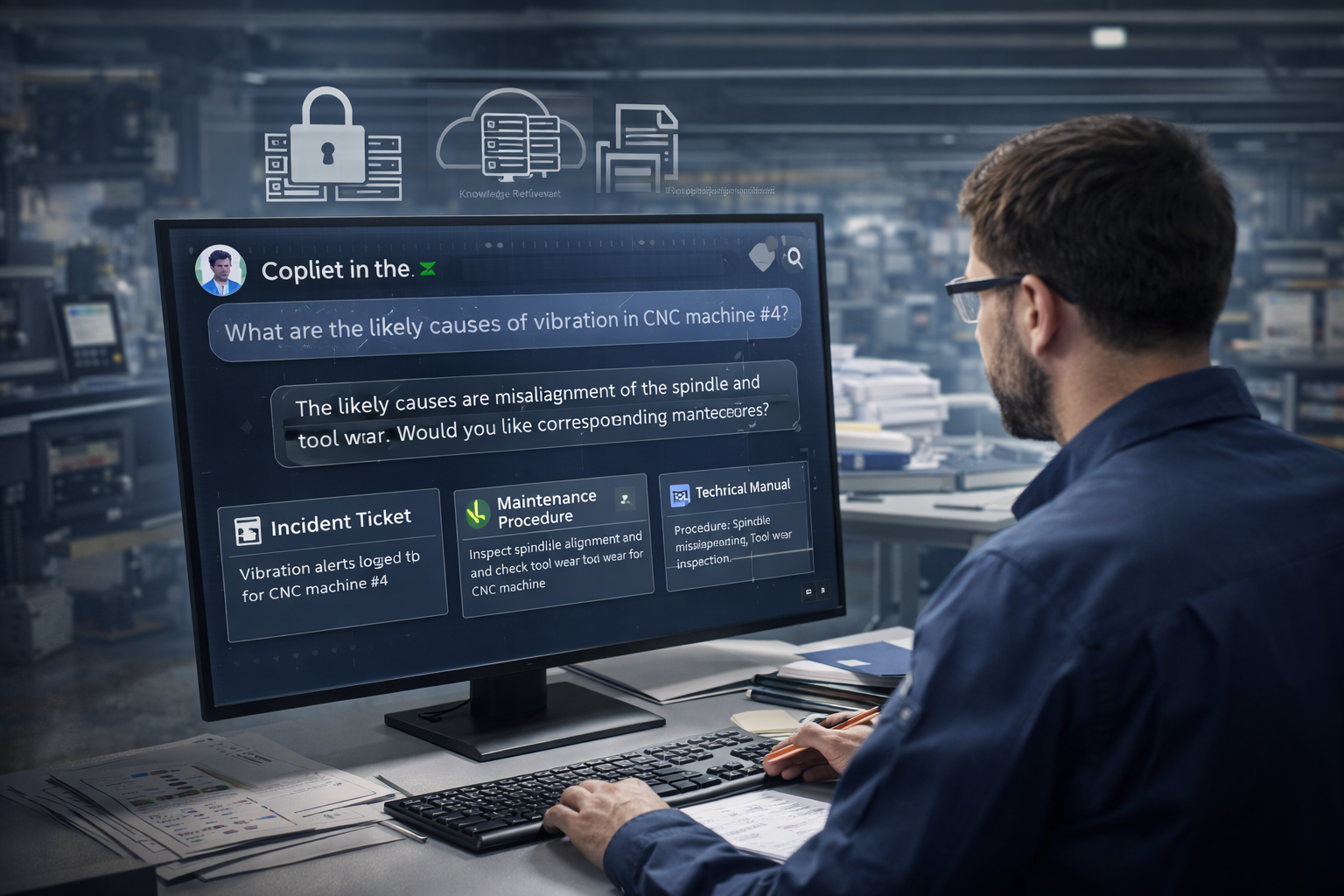
Large-scale language models open up new uses on the factory floor, as they include fault descriptions, interpret procedural instructions and dialogue in natural language with knowledge bases. They can thus become technical co-pilots, universal interfaces between operators and digital systems, and accelerate the capitalization of business knowledge.
COPILIO is part of this dynamic, with a strong constraint: making these capabilities usable in industrial contexts where data is sensitive, traceability requirements are high, and performance must remain compatible with limited IT resources. The project combined a structured review of the literature with an analysis of the deployment options available to the company, taking into account security, cost and integration issues.
Part 2: Challenges & innovation
The main challenge is not to produce long answers, but to produce useful, verifiable and actionable answers. To achieve this, COPILIO has focused on architectures that anchor answers in controlled sources and enable information traceability. The project has also focused on distinguishing between tasks that fall within the scope of a generative model and those that fall within the scope of specialized models that are lighter, faster and more robust on targeted tasks.
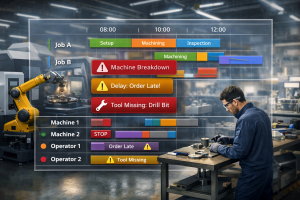
COPILIO’s innovation translates into a portfolio of concrete industrial scenarios covering real-time diagnostics, preventive maintenance, scenario simulation, compliance assistance, training and knowledge transfer, root cause analysis, maintenance planning, and technical documentation generation. For uses linked to document production and procedure consultation, the augmented search and generation approach is identified as a major lever for reducing factual errors and boosting confidence.
Part 3: Results
COPILIO has consolidated a clear reading of the state of the art, recalling the transformative foundations and evolution of pre-trained models for industrial tasks, in particular the families derived from BERT. Specialized models stand out as effective building blocks for classification and extraction. For example, a DeBERTa family for industrial tasks achieves an accuracy of the order of ninety-one percent for incident classification, compared with ninety-eight percent for a RoBERTa variant for the same type of task, confirming the value of differentiated selection according to criticality.
In terms of deployment, the project has objectively assessed the trade-offs between SaaS and local deployment. For a moderate volume, the annual cost of SaaS tokens is typically between ten and thirty-five thousand dollars, while a local service sized to absorb peaks can represent an order of magnitude of one hundred and forty thousand dollars per year for two eighty-gigabyte GPUs, excluding operations. These benchmarks enable us to choose a realistic trajectory according to sovereignty, latency and volume requirements.
Finally, COPILIO has put forward options adapted to the edge. An intermediate-sized model such as Mistral, with seven billion parameters, was identified as suitable for a local real-time co-pilot, with response times of the order of a few hundred milliseconds and reduced energy inference costs, subject to a documentary anchor to fill knowledge gaps.
Part 4: Outlook
The most direct prospect is to launch a proof-of-concept on a business process with a high return on investment, in particular costing and the preparation of quotations based on drawings, bills of material and historical data. A step-by-step approach is recommended, with systematic comparison to a reference costing and qualification of task sharing between human and system.
Beyond the prototype, success will depend on governance: quality of documentary databases, rights management, logging of requests, control of the dissemination of sensitive information and team training. The project also underlines the importance of integrating societal and acceptability dimensions, so as to make the co-pilot an augmentation tool, not a replacement.
Conclusion
COPILIO provides a pragmatic path from the promise of generative AI to reliable industrial co-pilots. The project clarifies high-impact use cases, risk-reducing architecture choices, and useful economic benchmarks for decision-making and deployment.
Author: Mehdi BOUKALLEL, COPILIO project manager, CEA-List.